
Want more market share? Test your goods and services with The Price of Ubiquity Theorem.
Learn the difference between something for one, something for all, and how to put your goods and services through The Price of Ubiquity Theorem.
Ubiquity – noun
presence everywhere or in many places especially simultaneously
If you want your product to be everywhere—that is to say, ubiquitous—then you must pay a price.
That price?
Simplicity.
The Price of Ubiquity Theorem
The more ubiquitous a thing, the simpler it must be.
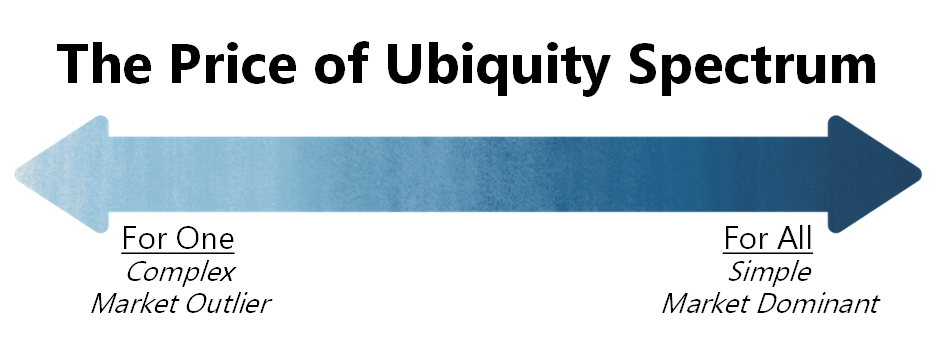
What do I mean?
When something is for one, only one person needs to use it.
When something is for all, then every person needs to use it.
Let’s explore this.
Something for one
When something is for one person, only one person needs to use it. It can be highly customized. This means it comes with a high barrier to entry and includes a steep learning curve. It also means nothing about it needs to make sense to anyone else.
No, really. Think of something only you do.
It could be your wakeup routine, your habits when you get to work, the way you approach your hobbies, or your nighttime routine. Whatever you do that’s just for you, consider how it suits you. It can be as custom as you want! Only you need to know how to use or do it. It can be built over time. The placement of every button or item, the flow of work from one step to the next, even the subjective things like color, shape, and size can work just for you. Things don’t even have to make sense as long as they make sense to you, the sole user.
This all works wonderfully for one person. It can be unique. It can be complex. Documentation? No need! As a product, it can be a market outlier because one person is an outlier.
But, when you start trying to teach other people your incredibly custom, unique processes, you soon realize an important truth:
Every person in the world is different than you.
That highly custom, boutique routine has a scalability problem. As I’ve come to call it myself, it’s “Too Cute.” All of my very custom, very cute things I’ve developed were always too complex for someone else to understand.
So, as you strive to bring your offering to more people, as you strive for market dominance, it must become simpler and more accessible.
Something for all
When something is for all, every person needs to use it. It must be highly streamlined. This means it comes with a low barrier to entry and doesn’t include a learning curve. It must make sense to everyone.
There are two great examples of this in the technology field:
Windows versus Linux
iPhone versus Android
Windows (and, for sake of argument, macOS) has a combined 90% of the desktop and laptop market. Linux? Just 5% of the same market. But, just how customizable is Windows when compared to Linux? Hardly customizable at all. Linux lets you do just about anything—but you must tell it what to do. Windows, on the other hand, lets you plug in a new device and, most of the time, the new device just works (printers excluded).
When it comes to iPhone, they own some 60% of the US smartphone market. This is down from the heyday when they had well over 80% of the market. What made it possible for iPhone to take off? Ease of use. It’s not uncommon to see toddlers with smartphones. Their little brains can adapt to just about anything you give them. But the real success was the octogenarians. When they first came out, I watched my then-82-year-old great uncle navigate a smartphone before I even had one. He was so proud to show off the pictures he took of his grandkids! Steve Jobs figured out that, for a thing to become ubiquitous, it must be easy to use. Android, of course, is a large percentage of the global market. I believe some of this success is due to Android streamlining their interface. For example, Google Pixel’s navigation looks and feels a lot like an iPhone. (I still watch people struggle with the “built-in buttons” I proudly keep present on my Android device!)
In each of these examples, the dominant providers like Microsoft, Apple, and Android all put their product through my Price of Ubiquity Theorem. They make their product simpler in order for it to become more ubiquitous. They found a way to lower the barrier to entry so that anyone could use it.
Is there anything that comes to mind when you think of a well-designed, ubiquitous product? Think of someone very different than you and they might also use the exact same product. What makes it so ubiquitous?
Put Your Products Through The Price of Ubiquity Theorem
So how do you do this for your products? In a word?
Simplify.
Let’s start with an example. Say you have a challenge: Get 100 people to submit a colored drawing of a countryside.
Say you have a room full of 100 people. You hand each of them a blank piece of paper and ask them to draw a picturesque countryside within 20 minutes. It’s almost a guarantee some of those pieces of paper would stay blank. Some of us are intimidated by drawing, especially when it’s something as lovely as a countryside!
Now, consider that same group of 100 people. You hand each of them a page from a coloring book that has a picture of a countryside. You ask everyone to color the countryside in the same 20 minutes. It’s very likely every one of the pages submitted would color on it!
How could you simplify further?
You could add numbers to the sections that correspond to colors! Sure, the paint by numbers approach reduces variety, but it lowers the barrier to entry.
This “blank canvas versus coloring book” approach can be applied to business as well.
Think of the Windows/Linux example. Windows comes with certain things pre-installed. Many of the games that were on the early version of Windows were even designed to teach you how to use the PC! Can you imagine if a smartphone came with nothing on it? Of course not!
But, that’s exactly how many people launch new products: as blank slates. Even Windows isn’t immune from this. With all the powerful things PowerBI can do, many people don’t anything with it because they don’t know how to connect it to the database, setup reports, and manipulate the data as they want.
The goal is to keep asking the question:
How do I get people to jump in and use this?
The difference between the blank canvas and the coloring book is that one of them is already set up. People can just start.
When you apply this to your business, it may help to think of it as templatizing.
By using the “Templatization Method,” you turn your product of infinite possibilities in a pre-determined set of starting points. The fewer, the better. This is one of the best ways to move your product along The Price of Ubiquity Spectrum.
To emphasize the importance of fewer options, look at how Steve Jobs first created the computer mouse. It had one button. Just one. There wasn’t anything to confuse the user on. Just click!
I have found this to be true in my own development projects. I created a tool that handled over $70M for a team of 60 salespeople. In the early stages, there were 2 buttons to generate a proposal. One ran the prerequisite checks, the other ran the proposal. Most of my “support calls” had me troubleshooting the same problem. “Bruce, the button doesn’t work.” After asking questions, I would almost always find the same answer: the user had pressed the first button. When I asked if they had pressed the second button, they all said the same thing. “No, should I press the second button? Ah!! It works!” It didn’t take long for me to build the prerequisite checks into the first button. With just one button to press, the questions disappeared.
Again, just because you streamline, simplify, and templatize does not mean you forfeit configurability. Sometimes the way to push things to the right on the Ubiquity Spectrum is to have things started, but that does not mean they cannot be changed. Even a Windows computer can be partitioned off and have an installation of Linux! You can both offer preset starting points and the option to reset the pre-configurations and start from a blank slate. I make sure and emphasize this because I’ve worked with far too many people who think streamlining means the loss of configurability or customization. This is not so! Keep your mind open as you explore just how accessible your offerings are.
There are many ways to gain market share. Use The Price of Ubiquity as your reminder to simplify. Simplify your pricing structure. Simplify the way people buy. Simplify your internal processes. Find ways to simplify, because the more people you want to serve, the simpler your offerings must be.
I don’t just teach The Healthy Company Framework. I equip people with their own set of templatized blueprints that enable everyone to get started on building a framework that helps them personally and brings a wealth of benefit to their company. If you’d like to learn more about how this can be done for you company, fill out and contact form and let’s get started!
The Price of Ubiquity Theorem and The Price of Ubiquity Theorem Spectrum were invented by Bruce McLeod. McLeod is an expert on helping companies gain market share, simplifying their offerings, and building better companies through The Healthy Company Framework.