
“Revenue is down.”
“Profitability is slipping.”
“Turnover is starting to hurt us.”
These are the top 3 problems I see:
Revenue
Profit
Talent
If one or more of these speak to you, this article is for you. I’m going to walk you through the diagnoses for each of these and show you how to recognize the warning signs and so you can act sooner.
Problems—or Symptoms?
Revenue
“Bruce, revenue is softer than we want. If we’re being honest, it’s been softer for longer than we care to admit.”
To this client, lower revenue was the capital P “Problem.” “If we just had more revenue, we could afford to cover all the mistakes we’re making.” But I help clients discern whether they have identified problems or just one of the latest symptoms, and they had just shared another symptom: “all the mistakes we’re making.”
“Tell me more about these mistakes,” I asked cautiously.
They went on to tell me about how they were used to making mistakes. They talked with pride about how well they historically handled them, too! Whether it was superheroes, putting together a reactionary SWAT team, or even outside help, they could always put out the fires. At least, that’s what they used to do.
What do you hear the real problem as?
Profit
“Our profit margin is disappearing, and we think we know why,” began another client.
“Oh? Why do you think that is?”
“People aren’t hitting their metrics. We’re hoping you can teach them how to hit the metrics. If we can just make the numbers look right, we can get our margin back!” Poor metric achievement was the Problem for this client.
As I worked with this company, however, it turns out this, too, was a symptom. A tougher case, but it turns out their metrics were measuring the wrong thing. And, you have to be careful what you measure. More accurately, you have to be careful what you incentivize. After all, people do what they are incentivized to do!
Talent
“We just can’t find the right people!” another cried, or rather, blamed. “We just can’t find good talent,” another similar client lamented. Their capital P Problem was People. “We’re losing our SMEs to other companies that are just buying people away,” one company complained. “To make it worse, the new hires just don’t know how to do things anymore!”
“What happens with the people you hire? What happened to the people who got you here?”
They went on to tell me how they had a rigorous onboarding team and trained people well. But, when I asked the managers how trained up the new hires arrived, they laughed at the idea they had been trained at all. “I wish they would stop hiring people,” the superstars would tell me. Ouch! I think I was getting closer to the root problem as to why profitability was suffering.
Though these clients had self-diagnosed their problems, it turns out they were all symptoms.
Warning Signs
Reduced revenue, piddling profit, and tug-of-wars for top talent are all lagging indicators.
Let’s dive deeper into these pains that were all ultimately past-due pains.
Revenue
As I worked with the first company, they had already admitted to important things:
They knew revenue had been suffering for a while
They suspected it was due to mishandling mistakes
This company made my job easier because they had already taken the first step of accepting reality: problems existed.
But what was really going on here?
For this company, their revenue woes were a symptom. They thought the problem was that the firefighters were tired. After all, they used to be experts at putting out fires!
As you might anticipate, the problem was that they had to put out fires in the first place. They unintentionally created a culture that rewarded firefighters. This worked well when the volume was manageable. But, like an overcrowded campground with too little rain, the fires started popping up faster, larger, and stronger than before. The staff did what they knew how to do: fight fires.
But what if they shifted towards preventing fires? What would that do for them?
Preventing fires (a key element of The Framework’s Self Healing component), as it turns out, would net more references. This resulted in an extra 6 to 8 new customers a year, an annualized revenue increase of about $750,000.
Profit
With the second client, they “knew” their profitability was due to missed metrics. “We just need to figure out how to get people engaged so we can make the numbers look right.”
This client was tougher because they first had to accept a hard truth: they were getting what they were asking for.
“But Bruce, they weren’t. The numbers weren’t being hit!” you might be saing. Ah, but what were the employees hitting? As it turns out, every single one of their measurements. Tickets were closed. Work was completed in the time given. Utilization looked high. As a matter of fact, utilization was higher in the less profitable division!
This ended up being the Trojan Horse that allowed me to open their eyes. “Your big issue is profitability, and you’re using Utilization as the metric to make sure people are working… so, why isn’t the more utilized group more profitable?” They didn’t have an answer.
As I worked with them, they adopted The Healthy Company Framework’s components of Units per Group and Success Scorecards. Putting metrics in terms of how people think of their work—not just how management thinks their work should look—they saw their profitability increase by several percentage points.
It was tough to get them to accept this, but they learned one of the hardest and best lessons a company can learn:
People do what you incentivize them to do.
Talent
“People just don’t want to work,” is an old phrase. This client, like many, thought the issue was finding the right people. This is certainly a challenge that has many solution facets.
First, I found one problem was the lack of definition around how to win at one’s job. This saw the same Units per Group and Success Scorecards solution used from the previous client.
Next, I found there was almost no way to offload information for the superstars. The Framework teaches companies how Documentation is the key to unlocking scalability, including when it’s used in the sense of scaling a person. Documentation eliminates bottlenecks and empowers others to learn quickly so superstars can focus on high-value efforts.
They also took The Framework to its third principle of connecting the business. As they connected their departments with the 20-60-20 approach, they were able to retain talent that wanted vertical and horizontal movement.
The impact for this company? They kept more top talent and ended up needing fewer FTEs to keep up with demand.
Read more on The Cost of an (Un)Engaged Employee.
Act Sooner
Pain is a lagging indicator.
As such, pain such as revenue, profit, and talent are often symptoms.
But, because this is often the language of management, they misread these lagging indicators as the problem.
If you are here, do not worry. The second-best day to plant a tree is now. The Healthy Company Framework teaches you how to start measuring things in a way that matters to the people doing the work. When you do this, you will see your topline metrics improve.
If you are ahead of the curve and looking to plant a tree 20 years ago (to finish the proverb) and avoid these problems, you will avoid these woes with The Healthy Company Framework.
The Secret Ingredient
Scalability.
That’s it. In a word, you and your business must stay scalable. Remember, as I said in the Profit example, a single person can be viewed as “scalable.” If you have anyone in your business who is “too expensive to promote,” you’re gambling that that person is not only scalable but that they aren’t human. Humans need a break. Humans retire. Keep people scalable. Keep your business scalable. Do this, and your revenue, profit, and talent woes will become much more manageable.
Let’s face it. It is easy to act when problems force you to. It is much tougher to be proactive, but being proactive is how you avoid the pain of lament. “I wish I didn’t always have to learn things the hard way,” is a phrase I’ve heard many CEOs say before. In each case, they ignored the anecdotal stories of their long-tenured employees.
I have yet to work with anyone more successful (at least from a financial perspective) than Jeff Bezos. He says that “when the data and the anecdotes disagree, the anecdotes are usually right.”
If your anecdotes are growing but your metrics still look good, now is the time to make sure your company is doing as well as you think it is.
If your data isn’t looking good, it’s still OK. There is time to right the ship. We can do it together. You’ll leave with the knowledge, skills, and confidence to set the ship right.
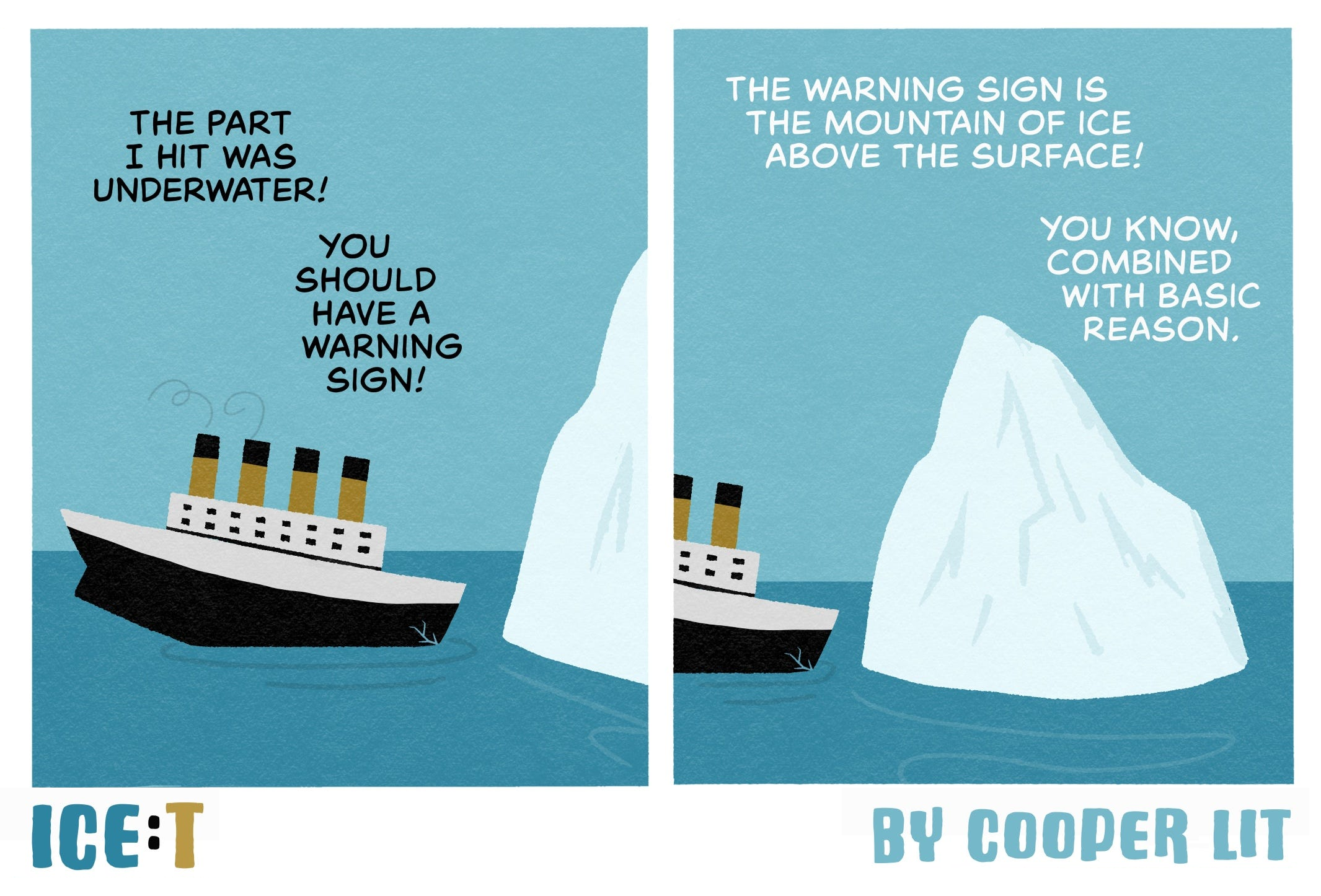
The warning signs are there, for those who are paying attention! Excerpt from a comic by Cooper Lit.