
Weaponized Incompetence or Zombie Creation? How to Empower and Give Feedback
Struggling with “lazy” employees? It could be a case of zombies!
If you want to empower others and have a team that acts, this article is for you.
Are You Creating Zombies?
What a question, right? After all, the height of the zombie craze wore off well before The Walking Dead ended.
But I’m talking about the zombies I see day in and day out in the companies I work with.
People come in, sit with their eyes glazed over, and wait. What are they waiting for? Whatever it is, they wait with a patience I have yet to achieve.
Orders!
They’re waiting for their manager to tell them what to do.
Most managers think the problem is the zombie. Of course they do! Surely the zombie is a laggard, inherited employee who doesn’t know how to take initiative. It’s always easier when the solution to our problems is the other person. But:
The secret to growth is realizing we’re the solution to our problems.
Let’s see if we have the brains (zombie joke) to take this topic apart. In three parts:
What is a Zombie Employee?
Is it Them or Me?
The Zombie Antidote, including a 4-step guide
What is a Zombie Employee?
Zombie employees. You’ve seen them. You might have them. You might have been or even currently be one. Typical zombie employees:
Don’t take initiative
Wait to be told what to do
Do exactly what they’re told
Rarely finish a job
What do these zombie employees look like in action?
Let’s take an easy example that should apply to everyone: retail. Not that everyone works retail, but everyone has been in a physical retail store to buy something. Let’s use a clothing store. Pretend you’ve gone into a store for the purpose of scrutinizing whether it’s well run or not.
Typically, you would see that items are organized. There’s a men’s section and a women’s section. In each, like items are grouped together. The pants are with the pants, the shirts are with the shirts, and so on.
Let’s suppose, however, that you notice several piles of shorts next to the pants. Several short sleeve shirts are mixed in with the long sleeve items. It’s not the worst you’ve ever seen, but you can tell someone hasn’t put things back where they go.
A zombie employee won’t do anything. They may or may not notice that something is wrong. What matters is that they don’t act. If the manager tells them to “put the shorts back,” they might put them back, but perhaps not exactly where they go. The manager would then have to say, “Please put them in the right order.” The zombie might go do it.
But the short sleeve items are still in the wrong spot. “Please take the short sleeve items and put them where they go in order with the short sleeves and fix the long sleeve section to close the gap where the short sleeves are.” Phew. That’s a lot of babysitting just to prompt a zombie to do their job!
But, what caused this to happen?
Is it Them or Me?
Let’s look at two kinds of zombies:
Innate
Created
Innate zombies are the ones who love weaponized incompetence. They are the people you hope to avoid hiring. Almost everyone I talk to claims their zombie employees were hired by someone else!
When someone uses weaponized incompetence, they go around acting like they don’t know how to do things. This is a tactic that, due to their caretakers, friends, or their own copious amounts of charisma, has worked for them. They can, of course, do the thing. They just find it easier to have someone else do their job for them.
“Oh, sorry, I don’t know how to do that. Can you do it for me?” the Innate Zombie might say 27 times a day. With Innate Zombies, you’ll find they often don’t stick around while you do their job for them. Watch out for these zombies! They may not be likely to infect the high achiever, but they are extremely likely to infect those who are like them.
The thing about Innate Zombies, though, is that it’s easy to spot them and fire them. There are job requirements, and if someone isn’t doing their job, it’s justifiable to let that person go.
Created Zombies, however, are more common.
Let’s go back to that clothing retail example.
You might observe that situation and feel bad for the manager that must babysit their zombies. But, suppose you’re able to watch this store over several days without anyone knowing. You begin to see a pattern. The newer hires want to help, but don’t know where everything goes and can’t always remember the exceptions. They put things in the wrong place and mess up. Of course they do; they’re new! Instead of helping them grow, however, the manager belittles them and beats them down. “You need to come to me before you make changes.” “Don’t think on your own; you’re messing up the store.” One feels shamed. Another visibly shrinks back. After a few weeks, you realize the newer hires have stopped taking initiative. “Another zombie!” the manager laments.
The case is just as common among long-tenured employees under new management. “Oh wow,” you observe. “Bob used to be proactive and do things, but ever since the new manager came in, Bob doesn’t do much anymore…” What’s going on here? Was Bob infected?
But, he wasn’t a zombie at the start… was he created? What about the other new hires?
When you look at these examples, I hope you draw the correct conclusion that these zombies were created because they were demoted into a high control, permission-based system.
Tell me if this sounds familiar in your workplace:
A new hire comes in, eager to help
They take initiative
They make mistakes because they’re overzealous
How do you respond?
If you’re not careful, you might respond like the retail manager who seems to be running a zombie creation machine!
The Zombie Antidote
Empowerment. That’s it.
Empowerment is the antidote to zombie employees.
And, to be abundantly clear, empowerment is for both you and those around you.
First, empower others.
Let’s again look back at our clothing retail example. What did the manager do? They took power away. New hires wanted to help and made mistakes. Instead of coaching them up, the manager took power away by saying, “I need to you come to me before you make changes.” This took power away from the new hires. Tenured hires who used to take initiative were now sitting idly because, once again, a permission-based system had been implemented. They were created.
“But they just said to check in first. What’s the big deal?”
Permission-first systems hit autonomy in two major ways. First, it blunts the desire for initiative. “Oh, well, I was going to do this, but my boss always gets mad at me and shoots down my ideas. I don’t want to go through that humiliation again.” Second, it limits the times initiative can be taken. Because action can only be taken after permission is given, that means you (the manager) always must be present. But what happens when you’re not there? What happens when you’re in a meeting? On vacation?
If you want to limit your growth, the growth of others, and knee-cap revenue, create zombies.
If you want to unlock the secret to growth, empower others to be their own problem solvers.
What could the retail manager have done differently?
They could have praised the initiative, pointed out what went right, added the missing information, and trained the new hires to try again. “Hey, thanks for taking the time to act on what you saw wrong. Tell me what led to you do it the way you did?” How much better this would have been!
A 4-Step Guide
Instead of creating zombies, use this 4-step approach:
Notice and praise the person’s actions
Be curious and understand where they’re coming from
Ask them about the missing information
Encourage them to make the missing parts look more like the good parts
Notice and praise that someone did something by choice. To scale your department or business, you must have people who think and act. Make sure you’re encouraging people who act!
Next, replace judgement with curiosity. Most people don’t just act. They have their own thoughts behind why they did what they did. Sure, perhaps it’s not in accordance with company policy, but it’s rarely out of malice. Understand others first.
After steps one and two, then you can ask about the missing pieces. “Do you know what the standard is for this?” They probably don’t! What a great opportunity to help educate someone so they can continue to act on their own in the future.
Finally, call out the good things they did—and ask them how they might make the rest look like that. This gets the person thinking about how they can act and create more of the good things they’ve already done. This results in the job getting done (or done more correctly), the employee feeling better about their choice to act and about their ability to grow and problem solve, and puts the manager in a better position. Wins all around!
Avoid the compliment sandwich!
The old “sandwich feedback in a good-bad-good” manner has been debunked.
Science shows us people only remember the one negative thing you said.
These steps are crucial to empowering others. And, if these steps still aren’t working, make sure an accurate picture of “complete” has been communicated. Make sure you can answer the question,
“What does success look like for the task I’m communicating?”
This picture of success is an essential part of making sure people understand their “Why?” When people know why their work matters, when their work has a purpose, you build in a good counterbalance that makes sure an empowered team doesn’t stray too far outside where they should be headed.
Do these steps and watch life come back to your zombie employees.
I provide this and other key insights to people in my coaching and training sessions. If you’re interested in learning more about what Company Connections can do for you and your company, contact us!
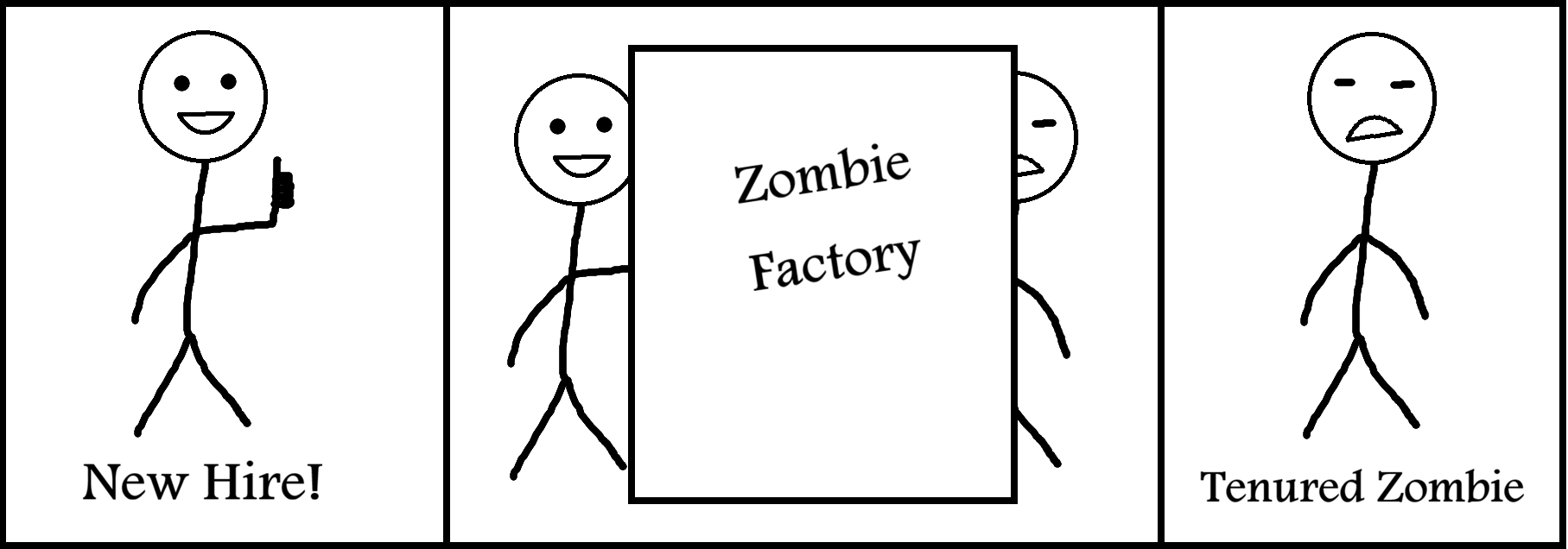
Does your business create zombies or help people’s spark shine brighter?