
Priorities, the Eisenhower Matrix, and Who Really Controls Your Life
This article is about the Eisenhower Matrix, how your choices reveal your priorities, and what you can do about it.
Who’s in control of your life?
I ask this in earnest. It’s not a trick question.
Who do you believe actually controls your life?
God? Fate? Outside forces? Your workplace? Your children?
The answer, dear reader, is you.
To solidify this answer, let me rephrase the question:
Who is in control of the actions you take?
You are. In everything, you choose your actions. Sure, we have reactions that are either hard-wired from genetics or learned from a lifetime of training. But, after the reaction passes, we choose our actions.
Our response is much more important than our reactions.
Let’s put this on an easy-to-digest grid.
The Eisenhower Matrix
“I have two kinds of problems: the urgent and the important. The urgent are not important, and the important are never urgent.”
– Dwight D. Eisenhower
The Eisenhower Matrix, also known as the Urgent-Important Matrix, is quite simple:
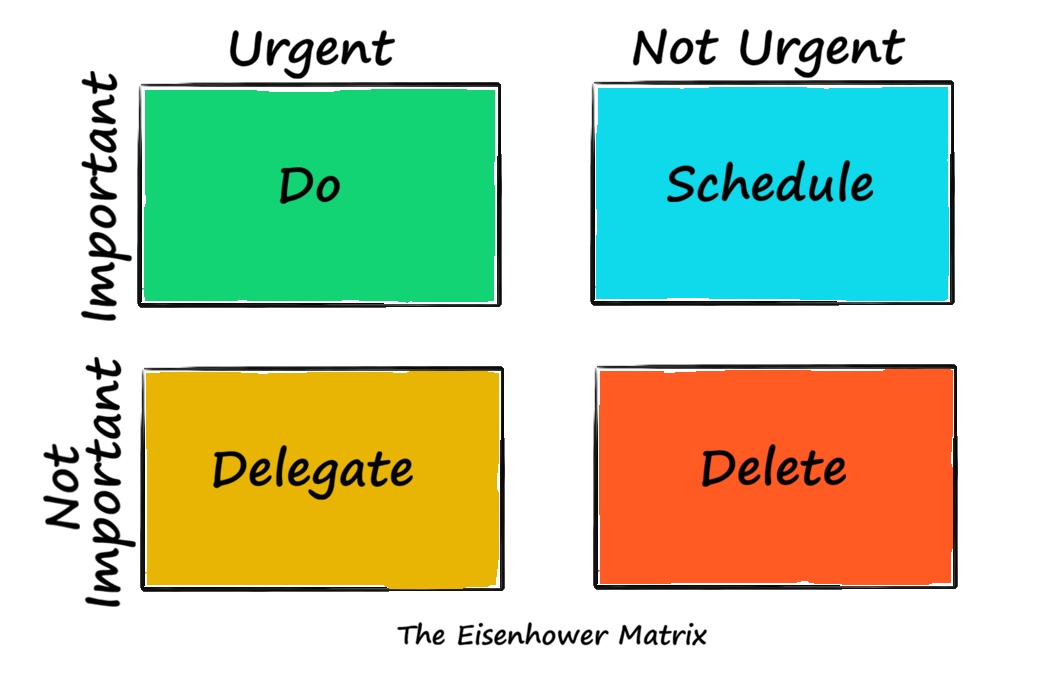
The Eisenhower Matrix
On the vertical axis is the Important. The horizontal holds Urgency.
It results in four quadrants:
Top left: Urgent and important
Top right: Less urgent and important
Bottom left: Urgent and less important
Bottom right: Less urgent and less important
Some may even choose to number these in this order, too, from 1 to 4. You should do the urgent and important things first, the less urgent but highly important things second, the urgent but less important things third, and the less urgent and less important items last—if you even do these items.
Some people choose to put a different label on these:
Do
Schedule*
Delegate
Delete
The urgent and important? You must do these things.
The important but less urgent? Schedule these things and commit to the scheduled tasks.
*If you like alliteration, call this one “Designate,” since you designate a time to do it.
The urgent but unimportant? Delegate that to others.
The unimportant and not urgent? Don’t even do these things. Delete them off your To Do list.
For more on the Eisenhower Matrix, I recommend these two short reads here and here.
A lot of people recommend using this to help you with your decision making. But chances are you’re not used to using something to make decisions. You just react.
So, first, track what you do.
Where do you end up spending your time?
Your Choices Reveal Your Priorities
Seriously.
Do this exercise. For a week, track your decisions and categorize them. Where do they fall in the matrix?
If you’re like most people who are letting life happen to them, most of your choices are in the top left. Emergencies, fires, and panicked situations dominate your day. And sure, you might think this is a good thing—it’s listed in the #1 spot, right? (But is everything you put in the top left really urgent and important?)
What about the #2 spot, the things you want to do? The things that will help you be who you want to be? Maybe there are some things in there, but you probably have more in the #3 or even #4 category.
And I get it. The #4 category can be the time wasters of things that don’t matter, but sometimes they’re the guilty pleasures that get us through the day.
If you’ve done this exercise, where do you spend most of your time and energy?
Most end up in #1 and #3.
Most people spend little-to-no time on the very important things that impact the long-term trajectory.
If this is you, you need to first accept the reality of where you are.
This is why I advocate for simply tracking where your time is spent. You must first accept reality before you can truly do something about it.
The good news, you can do something about it.
What You Can Do
Decide who’s in charge of your life.
Timothée Chalamet dropped a truth-bomb in an interview once stating:
You could be the master of your fate. You could be the captain of your soul. But you have to realize that life is coming from you and not at you, and that takes time.
Life comes from you. You are in charge of how you respond to the chaos life throws your way.
Do you want to spend your time on the urgent, ignoring the important?
You might reflexively say, “No, of course not!” but really ask yourself this question.
Do you let the “urgent fire” distract you from your long-term strategy?
If this is where you spend most of your time… it’s where you want to spend your time, even if it’s just because it’s what you’re used to or because you haven’t learned another way.
Maybe you like urgent fires. Maybe you like the feeling of reward you get from putting them out. Maybe you like the feeling of being needed. Maybe you like being the smartest person in the room and, therefore, keep other people ignorant so they have to rely on you. Maybe you just don’t know any other way.
Are you always pushing off the scheduled, important things due to impromptu, urgent fires? That may be life’s way of giving you repeat opportunities to choose differently!
Here are a few steps to consider if you want to take back control of your life:
Assess where you’re spending your time
Have honest conversations with yourself about why that is
Consider where you want to spend your time
Commit to building sustainable habits
As I’ve stated, you must first understand reality. It is important to understand what’s real so you can then take real steps towards change.
Next, be honest with yourself. If you’re not willing to understand yourself, you necessarily relinquish your ability to be in charge of your life.
Then, be intentional about what you want. Do you want to keep ignoring the business problems that matter? The time with your children you keep missing? The friendships you’re letting fade? What do you want?
Finally, commit to building sustainable habits.
“You don’t have to be great to start, but you do have to start to be great.”
– Zig Ziglar
Bonus
Another trick that may help you is to focus on adding the good. It’s less important to focus on removing the bad. Do this, yes, but you tend to shrink when you have a restrictive mindset. “Stop doing this, remove this, etc. etc.,” is a limiting, restrictive mindset.
“I want to add this sustainable habit,” is a growth mindset. You tend to grow when you have a growth mindset.
More on this topic is found in The Healthy Company Framework, including how people get stuck in survival mode
and literally lose their ability to think strategically!
I leave you with this:
You have more control than you realize.
Whether you’re searching to grow as a leader,
Get a better grasp of your business, or
Take back control of your personal life,
Company Connections can help.