
How Purposes Allow Predictable Patterns to Change and Adapt
This article is a continuation of The Manager Who Cried Wolf and the Power of Predictability published May 5th, 2026.
It reinforces the power of predictability, explores the dangers of doldrums, and how purposes allow predictable patterns to change and adapt.
The Power of Predictability
When you do things in a repeatable, predictable way, you give people a chance to become experts.
The power of predictability also teaches people what to expect from you. And, whether they realize it or not, they begin to anticipate their response to you.
When it comes to your business, you want predictability. Predictable revenue allows you to plan and make long-term decisions. A steady revenue stream allows you to add another business unit because you know you’ll have the capital to continue, even if the conditions of the market change.
When you look at regular reports, you want those reports formatted the same way each time. It empowers you to make faster, and hopefully better, insights. Can you imagine a scenario where the reports you receive changed formats every time you look at them? How drastically that would slow down your decision making!
Learned patterns are what make experts, experts. They begin to move instinctively when things happen. This allows them to beat the competition and stay ahead of tricky situations.
But, when predictability becomes an idol, complacency can be its unwanted companion.
The Dangers of Doldrums
Complacency sneaks in when people get too comfortable with their “routine” (another word for predictable patterns).
This carries a handful of undesired effects:
Routine problems
Problems become fires
Confidence in your business erodes
Customers and employees check out
Another way to say this is, “normal is what you’re used to.” Normal isn’t good or bad, it’s just your routine. So, when you rely on predictability, you run the risk of liking certain problems. Maybe you like being able to solve certain problems, so you want them to keep happening.
The concern is that these routine problems can become fires. Because you’re numb to their presence through familiarity, you don’t realize the damage these fires are causing. You like the accolades you receive for being seen as a hero. But the fact that the problems keep happening has adverse effects.
People lose confidence in your business. It’s fine if the problems are also no big deal for your employees or customers, but what if times change? A clue: times change. People don’t tolerate what they used to. Their expectations increase. They expect more from their business partners.
As you continue to fight the same ol’ fight and put out the same ol’ fires, your customers and employees lose confidence in your ability to be the provider of choice.
When you make predictability an idol, you become blind to repeated patterns of problems.
So, what do you do?
How Purposes Allow Predictable Patterns to Change and Adapt
The issue isn’t predictability, it’s what you’re applying the label “predictable” to.
Are you looking for the things you do to be predictable? Or are you looking for the purpose to be predictable?
These are the questions behind the question,
“Am I doing things right, or am I doing the right things?”
Let’s examine this.
When you look for things to be predictable, you start to focus on doing things right. You want your routine to be the same, even if the routine is, by definition of doing the same thing over and over again, insane.
You might train your workforce, “when this problem pops up, hit it with a hammer.” What you end up with is what you train: the best team of whack-a-mole players mankind has ever known. They’re doing exactly what they’re told. They’re expertly hitting the pop-up problems with the hammer you gave them. None of them are asking, “Am I doing the right things?”
But, what if you asked this question?
When you keep your Purpose in mind—the “Why?” behind your work—you start to focus on doing the right things. You want your routine to be the same, but recognize the routine isn’t in what you do, it’s the outcome from what you do.
Applying predictability to Purposes is what allows predictable patterns to change and adapt.
Instead of training your workforce to play whack-a-mole, you train them to understand why you need them. “I need you to put out embers and prevent them from happening. Let me know what tools you need to make that happen?”
When you do this, people don’t just react. They think and understand, “If we shift this way or that, we end up not having to play whack-a-mole at all.” They have now developed a predictable routine of problem solving, not rote action.
And what does this do?
Routine solutions
Problems rarely spark
Confidence in your business rises
Customers and employees engage.
Because your teams aren’t just trained to press buttons and swing hammers, they predictably find solutions. This means problems are headed off before they ever hit your radar. As they’re in the habit of prevent problems, confidence in your business rises. Customers and employees alike love working with and for you because they have learned: this company, predictably, solves problems.
These concepts are simple but implementing them in a lasting way isn’t always easy. The Healthy Company Framework gives you a way to do this in your business. Company Connections can help.
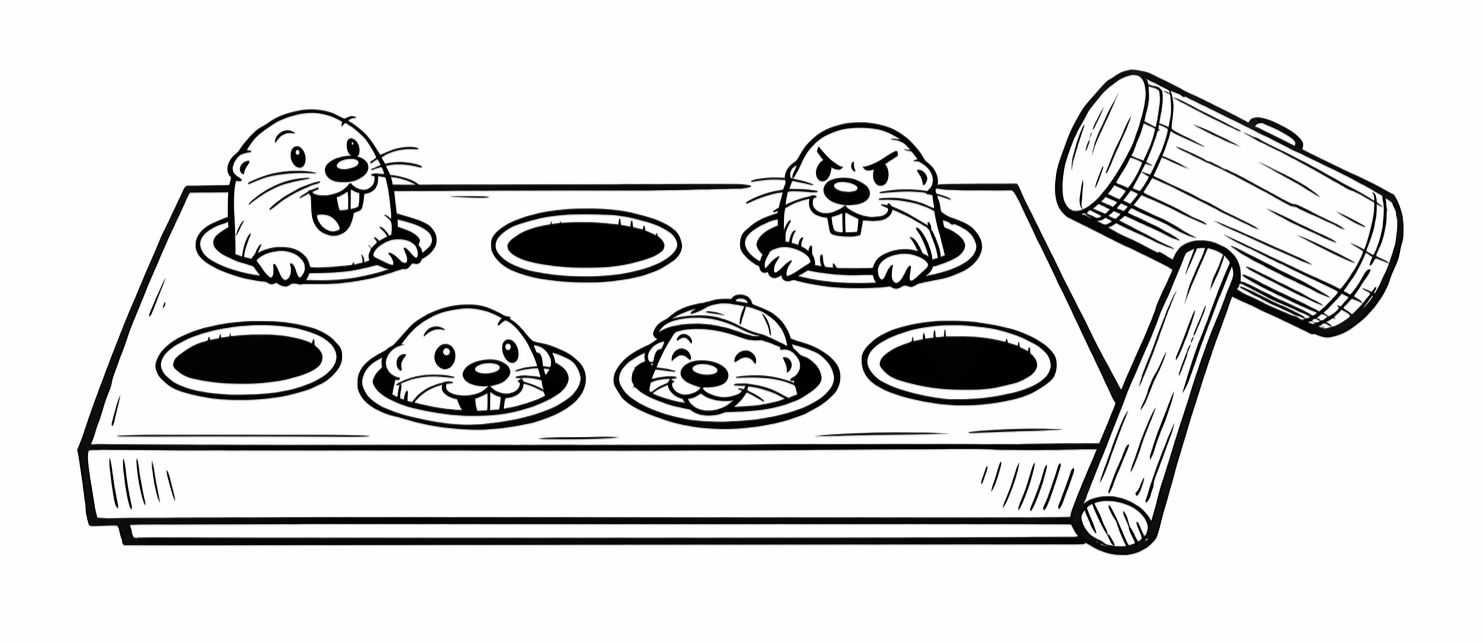
Tired of playing whack-a-mole? Use Purposes to make sure people understand why their work matters. When you do this, they start doing the right things.