
Closing the Employer-Employee Gap
This article is about the employer-employee gap, the impacts on business, and how to close the gap.
The Employer-Employee Gap
You’re stressed.
You don’t like how close expenses are to revenue. Maybe you’re already dipping into cash reserves. There are too many irons in the fire, and you’re stretched thin. The economy is in shambles, and you’re struggling to keep up. You’re not sure how your current offering will keep up with new demands.
Your employees?
They don’t like how close expenses are to revenue (their paycheck). They’re dipping into cash reserves. There are too many irons in the fire, and they’re stretched thin. The economy is in shambles, and they’re struggling to keep up. They’re not sure how they’re meant to keep up with current demands based on their dwindling bandwidth.
And when two, overly-stressed people try and communicate?
Miscommunication at best. Accusations galore with zero room for listening, most likely.
You’re too busy doing the leadership thing to realize: my employees haven’t had a pay raise that keeps pace with inflation in years. There’s more going on than ever, and with most people living above their means in a world where children are doing more than ever, they can’t manage to sacrifice for the company anymore.
Your employees are too busy trying to exist to realize: you’re drowning, too. You didn’t anticipate AI, government regulations, and a continuous stream of disasters that are making it difficult to lead a company.
It’s no wonder that employer-employee gap is ever-present and feels like it’s continually widening.
Impacts on Business
This “too busy to see what the other is experiencing” whirlwind impacts business.
Hidden ways
The customer is one of the first to notice. They used to reach a real person on the phone. Now they’re just a ticket. They used to trust their account manager to make sure things didn’t sit unattended or get lost in the gaps. Now, customers are not only babysitting, but they’re also helping train up new employees who seem to know less and less of how to get anything done. Long-time customers notice this because they don’t interact with your company every day. They interact with your company when they need something, and like it or not, they’ve been trained. They know what to expect, good or bad, and notice when the norm changes.
If the customers are first to notice, next is the frontline employee. The employee doesn’t notice this gap first because it’s gradual. They experience it every day. So, their recognition of shifts and changes are affected because they’re so familiar with things. Micro shifts day-in and day-out take a while for someone who’s in them every day to notice. But when they do? Oh boy, are they aware of it. They know how things used to be and feel powerless to do anything about it!
Only after months of the frontline complaints does middle management begin to realize something is amiss. They’ve been so focused on what upper management wants to realize they’ve drifted away from what their team does, let alone what they need to succeed. This is why the fourth area to feel the impact of the business is more obvious.
Obvious ways
The most obvious impact of the employer-employee gap, of course, is profitability. Money covers a multitude of sins, especially in business. There is no need for concern about what middle management says, about the random break room chatter, nor about the odd customer complaint when the money clearly says, “Everything is OK.” That’s why profitability is one of the more obvious indicators. However:
Sinking profitability is a lagging indicator.
That’s why waiting until this obvious sign of sinking profitability is something you must not do if you want to stay ahead of problems. But, sadly, it’s this indicator that finally gets the attention of the fifth and final group to feel the effects of the employer-employee gap:
The employer. That’s right.
The last people to feel the pain of the employer-employee gap is company leadership.
The business owner and those that report directly to the CEO are often the last to feel the effects of this employer-employee gap. By the time they are aware of it, it’s obvious because it’s been going on for so long. It’s easy to see large problems. The difficulty, of course, is knowing which “small problems” will grow into big ones.
That’s when you must face:
Reality
Only when you accept what’s real can you see what’s going on. The reason we date people who aren’t a good fit is because rose-colored glasses make all those red flags just look like celebratory flags.
What rose-colored glasses are you wearing today when you look at your business? What’s keeping you from seeing what’s going on with your business? You must step outside your world to see what’s happening. Just as good decisions can’t be made in a vacuum, neither can reality be seen through one lens.
How to Close the Gap
In four steps:
Accept reality
Own your impact
Define success
Create connections
Accept Reality. This is a very simple thing to do, but it is not easy. The longer you wait, the harder it is to accept reality. That’s why it helps to have definitions. A recession is historically defined as “two consecutive quarters of negative growth.” Is your business, then, in a recession? What definitions do you need to create to accept reality?
This step will look different for every individual, but it is the most important step. Without it, you cannot hope to:
Own your impact. This is often why it’s so difficult to accept reality, because after you accept the current state of things you often find: it’s the consequences of my own (in) action.
Read Achieve Your Goals by Owning Your Impact for more on this topic.
If you have direct reports, you must realize it’s your responsibility to equip people with the best chance for success. To do this, you must:
Define success. The Healthy Company Framework doesn’t complicate this. It’s not enough to apply company measures to groups or individuals. You must use Units per Group that put work in terms of how people think of their day and give them an objective path to success with Success Scorecards. This is how you proactively help your team(s) know what winning looks like.
But as we’ve said, departments and silos aren’t all there is. You must finish the fourth step and:
Create connections. Again, The Framework equips you with how to do this. In the third principle, it’s explained how you cannot simply know how to do your job. You must know where your work comes from and where it goes. By creating these First and Last 20 percents, you create connections throughout your organization.
It’s these connections that keep people connected as you work to repair the employer-employee gap. Not only will employees feel more connected to their boss, but they’ll be more connected to other departments. As departments begin working cohesively, the business begins to feel more like a singular units as opposed to a patchwork of misaligned departments.
If you’re looking to close the employer-employee gap. If you’re looking to get a better grasp of all the disparate components of your business. Contact us. We help businesses just like yours become experts in solving these issues at your company.
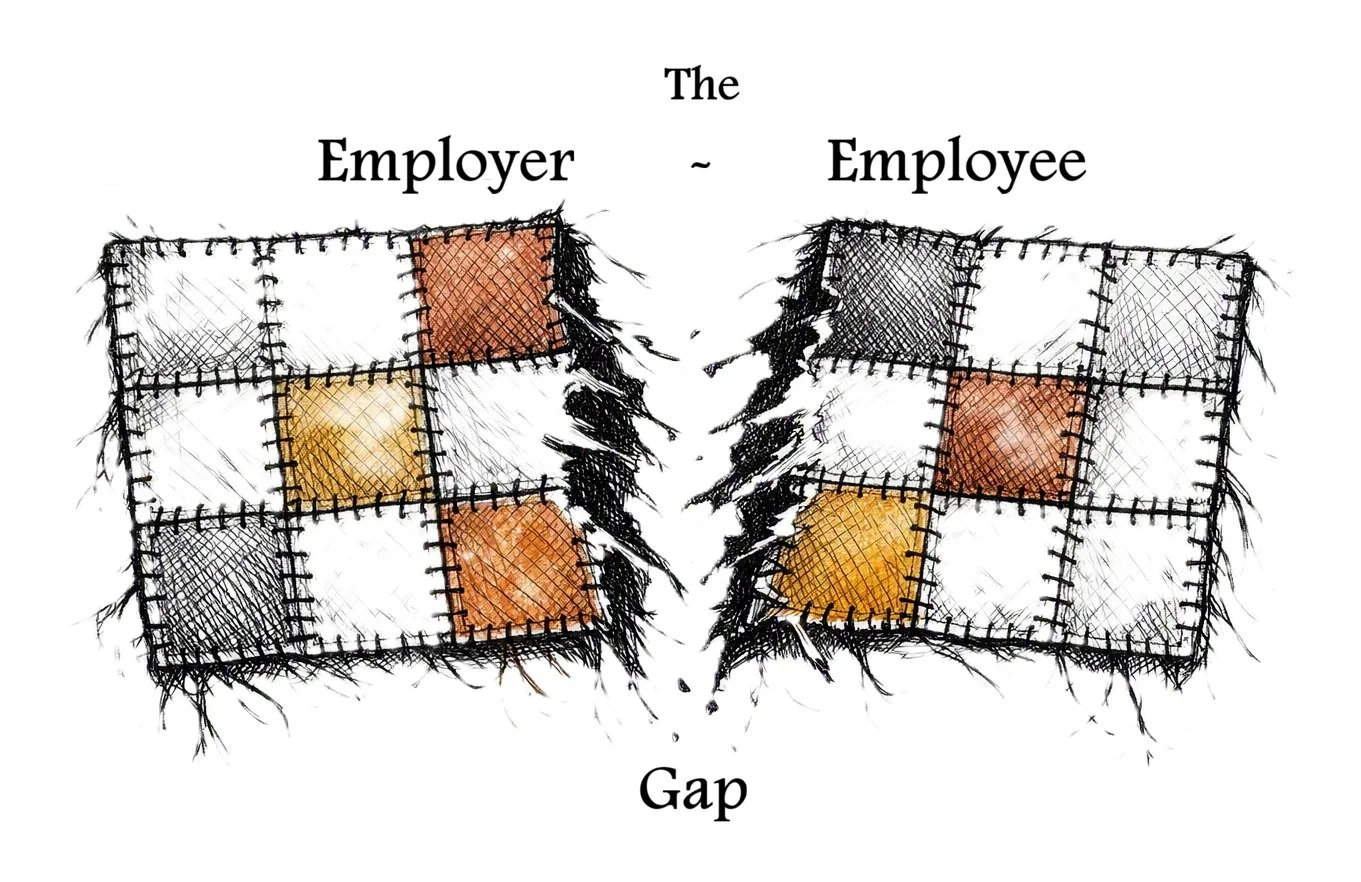
The Employer-Employee Gap may be tearing apart the fabric of your company. Learn how to mend it!