
To Leave a Legacy
What does it mean to leave a legacy?
Is it as simple as being remembered? There are tons of people remembered for things we’d rather avoid, so that can’t be it.
Does it mean having a positive financial impact on those around you?
Or do you wish to leave the world, or at least your world, better than you found it?
Whatever it means to “leave a legacy,” most definitions include a common theme:
something that outlasts you.
In the business world, that often means your business or company lasting far beyond your tenure.
Whether you’re a business owner who hopes to sell or pass on your business, or whether you’re a superstar who hopes to fix a critical problem before you move on to the next business that needs your superpowers, the desired impact is the same:
Let me build something that continues on its own past my involvement.
What often happens, though?
You become stuck.
The very thing you hope to build and perpetuate becomes the albatross around your neck that causes the crew you hoped to inspire to view you with skepticism and disgust.
I argue the quintessential prerequisite for leaving a legacy is this:
Have both the courage and humility to let go.
You must let go of a thing to leave a legacy.
If you continue to hold onto it, you run the risk of crippling those who might benefit from and carry forward your ideals.
This is often the case of such CEOs and superstars who prevent ‘the next generation’ (be they a person or literal generation) from making changes.
Worse still, many leave the next generation feeling ‘tricked’ by delegating power, only to revoke it at the time of implementing a decision.
But how do you let go?
Prepare the way with these three steps:
1. Point people in the right direction
2. Equip them to pick up where you left off
3. Connect everyone with each other
Starting off:
1. Point people in the right direction.
Vision and the purposes that tie people to it must be more than a person.
When the very reason something exists is because of a person, it is necessarily true that when the person changes, fails, or ceases to be involved, the thing that exists also ceases to exist.
Maybe not in an instant.
Maybe not entirely.
But when the source of something’s being is a person, the something cannot exist without said person.
So, if an essential element of leaving a legacy is to have a thing outlast you, you cannot be the sole reason for the thing.
This means that you, dear reader, must move beyond being the sole superhero who does everything.
Your job, then, is to point others in the right direction.
It’s not as simple as stating a destination, either.
The clearer you can create a picture of where you’re trying to go, the more people can help you get there.
Do this by helping people understand what they must do nestled firmly underneath why it matters.
People will get lost in the weeds.
They get lost in the weeds because that’s where the work is done!
As someone who wants to leave a legacy, do your best to help them sit a few inches taller. Raise their heads up to make sure the good work they’re doing supports why they’re doing it.
Having established a vision others can follow, next:
2. Equip them to pick up where you left off
It’s one thing to be the best.
It’s another thing entirely to set up the next person to pick up where you left off and make the thing even better.
The best way to get started on this is to document what you do.
Not once, but always.
The idea that documentation is a one-time event is a fallacy.
Documentation is ongoing.
A perfect system isn’t built once and never touched again.
The perfect system is the one that can constantly morph, change with, and absorb the new things that the world demands from it.
Asking people to ‘figure it out’ is how you guarantee the same mistakes will be made over and over again.
Asking people to follow a rigid system of strict, archaic documents is how you ensure your company fades into nothingness as your competitors adopt new technologies.
Constant vigilance in updating your documentation, solving problems in both a reactive and proactive way, both trains newcomers and teaches them how to adapt and growth with the vision you’ve set.
You must take one final step to leave a lasting legacy:
3. Connect everyone with each other
In the chaos of the day, you may only have a brief moment to bark the order, “Just do what I say!”
What that creates, when copied and pasted over and over from VP to Director, Director to Manager, and Manager to front line, is a body of people who are simply “good soldiers” who “do what they’re told.”
After all, good soldiers follow orders, right?
But this mindset creates blind obedience, not cohesive synergy that carries your vision forward.
There’s a saying:
There’s never time do it right the first time, but there’s always time to do it again.
That is to say, many people fall into the trap of thinking, ‘I don’t have time right now. I’ll come back and fix it later.’
The trap is, of course, that you don’t come back and fix it later.
You step on the same landmine, over and over, each time you revisit the task.
But.
If you connect people with each other and help them understand the handoffs between each step in the process, people become more connected with how their movement impacts those around them.
And what does this do?
This connection helps people understand their impact. It helps people see how they can choose where they’re going and what they want to achieve—even when you’re far removed from the picture.
That’s how you leave a legacy.
Whatever you want for your legacy, whatever your reason for wanting to leave a legacy, do these things, and turn your albatross into a gift.
Finally, end with the courage to let go and watch with joy as your legacy transforms into something new.
Company Connections was created to help you, be you an individual of a flourishing business you founded or be you a superhero fighting burnout, do this and more. If you’re interested in learning more, let us know.
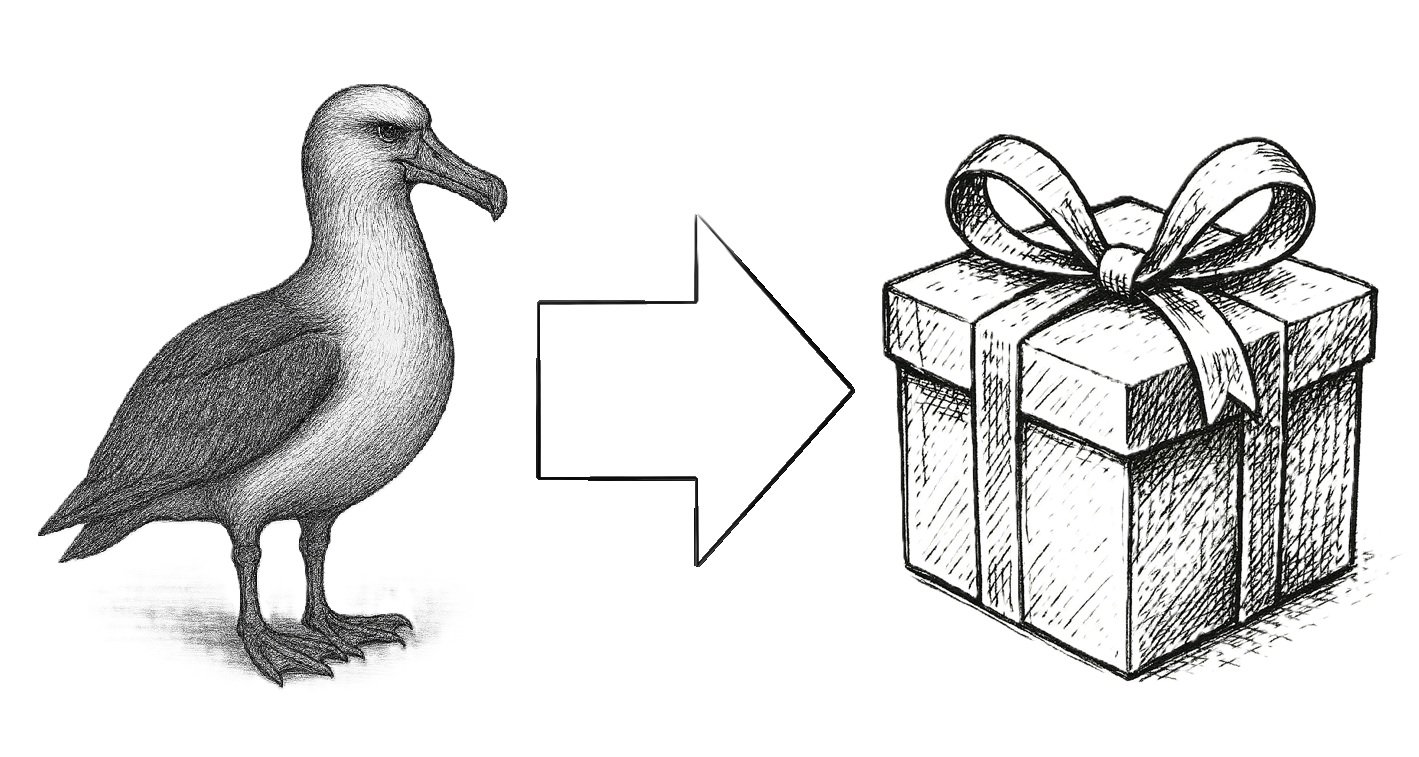
Turn your albatross into a gift!