
How to Fix Middle Management
This article will teach you what to look out for so you make informed choices and give you the tools to set up any leader for success.
The Peter Principle:
In any hierarchy, an employee tends to rise to their level of incompetence and that’s where they stay.
Said differently, people have competencies and excel at certain roles. They get promoted. And, if they’re good at that, get promoted again. But at some point, the person reaches a level that’s beyond their ability. It could be a salesperson who only knows how to sell but not how to manage. It could be a great manager who can’t think strategically enough to excel as a C-suite. It could be a business owner who can’t grow their business beyond a certain point. Whatever the case, at some point, the promotions stop.
To accept this and say, “Then, there’s nothing I can do,” however, is defeatist.
Let’s take a different view.
What to look out for
Internal versus external job satisfaction.
People who are internally satisfied are those who are happy in their work. It’s becoming more common for people to be happy with their position and don’t want anything more. Gone are the days of, “Everyone wants to climb the corporate ladder.” And you know? That’s OK!
The people you want to promote are the ones who, internally, want more.
You must also look at whether the person can externally satisfy the job requirements. Someone might want to take the next promotion (not internally satisfied) but have demonstrated they cannot handle the demands of the position.
This is most obvious after the person has had a chance to prove themselves. Be careful not to use absence of experience as a reason to deny growth. Sometimes a bigger pot is needed for a plant to reach its full potential. Be cautious of keeping people in too small a pot!
The people you have promoted must, within a reasonable timeframe, prove they have satisfied the job externally.
Ultimately, you want to promote people who are both internally dissatisfied with staying put and externally capable of doing more.
Many leaders have made the mistake of thinking, “If a person is internally satisfied with where they are and are externally capable, then they should take the role.” This is a recipe for burning out that individual or losing them. If this is a foreign concept, think about the teachers you had that, quite clearly, didn’t want to be teachers. How well did you learn from them? At least for me, the main thing I learned from those teachers was that, “I don’t want to be stuck doing something I don’t want to do.”
But if you’re supposed to find out after giving people a chance to prove themselves externally, how do you that?
The Tools
Provide individual metrics that tie to company metrics.
One reason people excel is because they understand the thing they’re doing. They understand not only the outcome but also understand the individual components necessary to excel at the task. These are the people who have demonstrated how to achieve repeatable success.
It’s possible these people even taught themselves how to achieve success time after time. However, it’s not fair (or business smart) to ask people to do this at every level, especially when the health of your company is on the line.
Your business likely has macro metrics that report on the health of the company. These often appear in the forms of KPIs (key performance indicators), OKRs (objectives and key results), or even a P&L (profit and loss). These are the goals of the work your business does. They tell a picture of how you’ve done. They don’t often tell you anything about how you’re doing today.
Today is what causes the results the company measures show.
Starting with the CEO (or shareholders, even!), the practice of understanding what you do day in and day out to achieve success must be modeled. The Healthy Company Framework calls these Units per Group. They represent the loops of work you do that cause the outcomes you want. Many business leaders have rigorous routines. It’s those routines that result in their success.
As the business leaders demonstrate and do this, the manager is then equipped with two key elements:
The Business Goals (the KPIs, OKRs, etc)
The Tasks for Success
When people get promoted to management, it’s my observation that one of two likely outcomes happen:
The person lacks an understanding of how to connect to the business goals and therefore gets stuck in the weeds.
The person loses connection with the details and alienates the front line.
In either case, it’s a bad result for the company.
Hopefully this is painting a picture as to the demands.
Managers have the difficult task of balancing on the tightrope that is understanding how the details support the next layer of the big picture.
Putting it all together
If you have a frontline that complains about their manager, it’s likely your management team has lost connection to the details. When managers just parrot the company line and speak in corporate jargon, they’re likely hiding the fact that they don’t understand what people do or how their work moves the needle.
Help this individual by getting them to create and manage with data that reflects what people do day in and day out—not just the corporate measurements.
If you have a manager that can’t seem to recognize that there is a forest and is zoomed in on the bark of a single tree, there are two things to investigate. First, make sure you understand what they do. It’s possible you have alienated your direct report and their attention to detail is their way of trying to make sure things keep going smoothly! Second, after you’ve made sure you’re not glossing over the important things their team does, get them to start looking at the corporate measures. Chances are that an individual stuck in the weeds is missing how their work (or lack of work) affects the whole.
And, at some point, it may rest on you to make a tough decision. If a person isn’t externally satisfying the requirements of the role, you may have to demote that person or let them go. This is rarely “nice” (which tends to focus on the immediate feelings of an individual), but it can be “kind.” Kindness meets the need. When a person is failing at their job (whether they see it or not), removing them from that position is a form of kindness to the individual, the team they’re managing, the managers they work with, or the business you’re trying to run. (If you doubt this, go talk to the people around a bad manager—they’ll tell you it’s kinder all around to get them in a place where they’ll excel!)
This is but one glimpse into how The Healthy Company Framework can impact your business and how Company Connections can help you and your team achieve the results it’s looking for. If this message resonates, let us know. We’d love to learn more and help you on your journey.
For a blast from the past, check out this BBC Archive footage about the Peter Principle from the creator himself, Dr. Laurence J Peter. https://www.youtube.com/watch?v=39wzku9KIEM
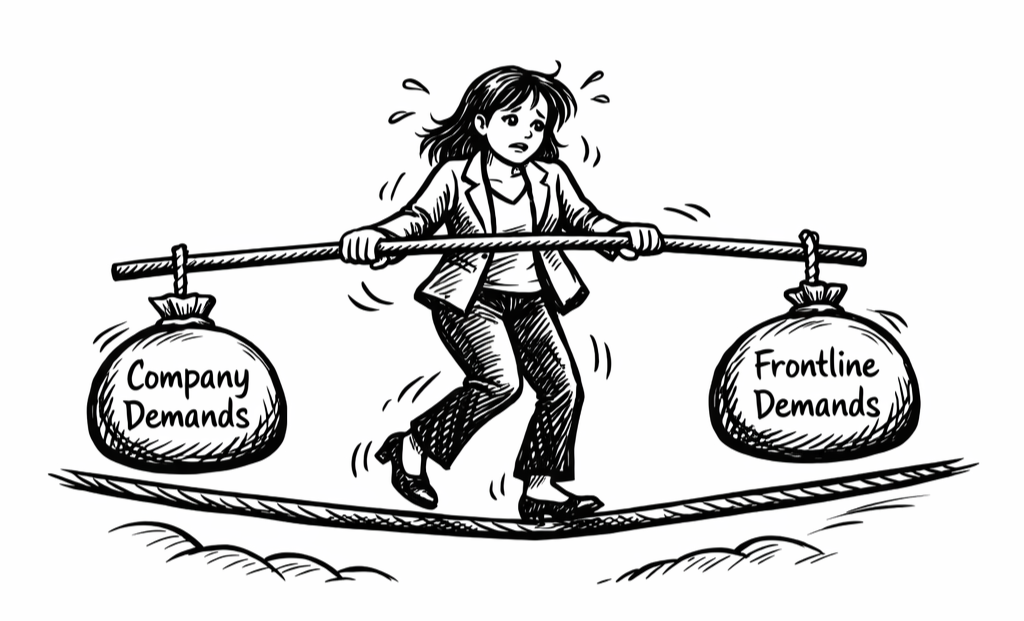
Managers have the difficult task of balancing company demands with frontline demands. Help stabilize your managers on the tightrope you’ve asked them to walk with the right tools!